In recent years, the world of livestock farming has undergone a profound transformation. While attention was once focused mainly on genetics and nutrition, another determining factor is now emerging strongly: the farming environment.
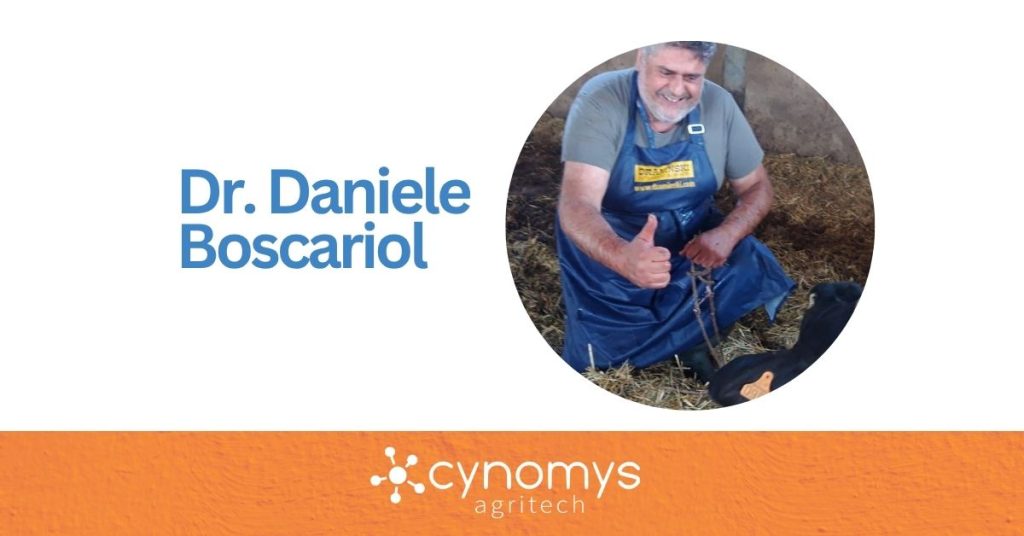
We interviewed Dr. Daniele Boscariol, a bovine practitioner, farm veterinarian, and reproductive consultant for several farms in the Lodi, Milan, and Pavia areas, to understand how practices in barns are changing, what often invisible challenges exist, and what role technology—and veterinarians—will play in the coming years.
Over the years working closely with farms, what has been the most evident change you’ve seen in the relationship between the farming environment and animal health?
Ventilation. The improvements made in ventilation are, in my opinion, what have had the strongest impact on improving welfare. I’ve seen clear improvements especially in July and August: when I started working, there weren’t all these fans—or at least they weren’t as effective as they are today—and I’ve really seen a major improvement.
Today, humidity coefficients are taken into account, along with many other factors. In fact, we now use fans even in winter, when we used to think they should be turned off and left to collect cobwebs. Now they may run at a low speed, but they help circulate the air, improve ventilation, and enhance air quality by reducing gas concentrations, making the air more breathable.
This is, in my opinion, one of the most evident changes of recent years.
There’s a lot of talk about nutrition and genetics, but less about air quality. Based on your experience, how important are parameters such as ammonia, fine dust, and CO₂ (carbon dioxide) in the daily life of animals?
I believe they are fundamentally important. Just look at barns from the 1970s compared to those built today. Back then, barns were completely closed, with many windows that could be opened or shut, and large doors that were often kept closed.
Today, instead, you often have just four pillars and side curtains to reduce wind while still allowing essential airflow. Perhaps also due to climate change, the situation has completely changed. Ventilation has improved, and we no longer have those unlivable conditions of closed barns with strong ammonia odors.
At the same time, we see improved production—not just because of genetics. If we take animals with strong genetic potential and push their nutrition, they actually suffer more in poor environments compared to more rustic animals.
If I think of a Valdostana cow kept in a small stable all winter, it doesn’t have major issues. But if I take a high-producing dairy cow with a very intensive feeding regime, it would certainly struggle much more in poor air conditions.
Can you share a case where an “invisible” problem—perhaps related to ventilation or air quality—had significant effects on health or productivity?
Yes. There was a farm with slurry tanks located to the north. Since we are in the Po Valley, the prevailing winds also come from the north, carrying ammonia and other gases into the barn.
In that barn, we observed clear respiratory issues — not severe, but worsening at certain times of the year. By installing angled fans to improve air circulation, we managed to reduce these problems.
Even though we — like the animals — get used to the smell and stop noticing it, gases such as ammonia, methane and hydrogen sulfide are still present in large amounts, and they do cause issues.
Summers are becoming longer and hotter. From your perspective, what do you observe most in animals under heat stress? And which solutions have proven most effective?
I’ve partly answered this already: ventilation is the key. Thanks to improved ventilation, I no longer see animals with their tongues out, struggling to breathe, reducing feed intake and drastically dropping milk production.
The situation has improved significantly. Animals are clearly more comfortable — I don’t see those extreme conditions anymore, with animals heavily panting, soaked or visibly distressed.
Considering that temperatures have increased, this is a major improvement.
Today it’s possible to monitor almost everything in real time. From a clinical perspective, how does having continuous data on microclimate and animal welfare compare to traditional observation?
Absolutely — it allows us to focus on prevention. Having data means we can anticipate problems instead of intervening only after disease appears.
Monitoring gives us the ability to prevent situations from worsening, which is exactly what modern veterinary medicine aims for: prevention rather than reaction.
There is increasing talk about artificial intelligence and predictive systems. Do you see them as tools that can support veterinarians, or could they replace some of their skills?
I don’t think AI can replace veterinary expertise. However, it can be a very useful tool for data processing and making information immediately accessible.
It can turn raw numbers into something meaningful and actionable.
In France, consumers see a rating from A to E on animal welfare labels (similar to Nutri-Score). How do you view this type of communication? Would it help or hinder Italian farmers?
At this stage, it would likely help. Of course, we shouldn’t push it to extremes or demand unrealistic changes that require massive investments.
But providing reassurance to consumers that animals are not mistreated is important. It’s a useful communication tool and can also help address existing concerns.
At the same time, it supports better production and improved animal health.
There is growing discussion about farms that “give back” to the environment, improving soil and biodiversity. From your perspective, is this realistic or still utopian?
It’s realistic, but still a long road ahead. That said, you always have to start somewhere — the first step is essential, and then you need to keep moving forward.
The environment is not just a marketing concept — it directly affects our own health. Especially here in the Po Valley, we need to improve conditions, otherwise even the air we breathe could worsen.
Many farmers see sustainability as a cost. Can you give an example of when improving animal welfare led to a real economic benefit?
Ventilation is probably the most evident example. In the past, a drop in production during summer was almost taken for granted: “In July cows produce less milk — it’s normal, it’s too hot.”
It was also considered inevitable to lose some animals due to heat stress.
Today, however, this is no longer the case. With proper ventilation, there are no significant drops in production during July and August, nor losses related to heat.
This translates into a clear economic advantage: greater production continuity, fewer unproductive days and more stable herd management.
In other words, you gain consistency, efficiency and reduced losses — and that’s the most visible benefit.
Looking ahead ten years, what do you think will be the biggest challenge: climate change, economic competitiveness, or integrating technology?
I don’t see these as separate issues, but as three deeply interconnected aspects.
They represent the key points we must consider: climate change, technological evolution and the ability to use these tools to face new conditions.
For this reason, they cannot be separated. All three are essential and must be addressed together, with an integrated and coherent approach.
Conclusion
The interview with Dr. Boscariol highlights a key point: the evolution of livestock farming increasingly depends on often invisible factors such as air quality, ventilation, and microclimate management.
Today, the challenge is not only to produce more, but to produce better—with greater attention to animal welfare, efficiency, and prevention. In this context, technology and human expertise do not replace each other—they reinforce one another.
The future of livestock farming will therefore be increasingly based on data, awareness, and adaptability—but also on valuing the people who work in the sector every day.