The agrifood sector in Italy has been, especially in recent years, affected by a strong push for innovation. Although it is one of the historically oldest sectors and therefore less prone to change, agrifood is little by little revolutionizing processes and habits both internally and towards consumers in favor of the contribution of new technologies and greater attention to certain values such as animal welfare, sustainability and transparency along the entire supply chain, from producer to consumer, from stable to table.
In general, in all production sectors, we talk about transformation to 4.0: a revolution that affects companies and businesses committed to implementing new technologies, called enabling technologies, in their production and organizational processes along with increased digitization.
So can we talk about Industry 4.0 for the agrifood sector as well?
The answer is definitely yes. A number of new terms have also sprung up to better indicate this change, such as: agrifoodtech, livestock 4.0, precision agriculture, Smart Farming, and agrizootech.
In our #Glossary we have tried to clarify with simple and accessible definitions some words related to the terminology of innovation 4.0.
You can find all the glossary definitions in the album on our Facebook page.
But before we talk about Breeding 4.0 and Agrifood tech, it is important to take a step back and dwell on what are the enabling technologies in this sector and how they can be used to benefit breeders and farmers.
Enabling technologies what are they?
Enabling Technologies or KETs(Key Enabling Technologies) are drivers of innovation, and in them are identified those technologies, recognized by the Industry 4.0 Plan first and Transition 4.0 later, as fundamental to growth and employment, capable of developing solutions and technological improvements through research activities.
As defined by the European Commission, KETs or Enabling Technologies are:
“knowledge-intensive and associated R&D-intensive technologies, rapid innovation cycles, substantial investment expenditures and highly skilled jobs.”
As of the National Plan, they have been divided into 9 macro-categories:
- Advanced manufacturing solutions: Interconnected collaborative robots (Cobots)
- Additive manufacturing: 3D printers and scanners connected to prototyping software systems
- Augmented and virtual reality: Augmented, mixed and virtual reality systems
- Simulation: Industrial Simulation Tools
- Horizontal and vertical integration: Vertical and horizontal integration solutions
- Industrial Internet of Things: Industrial connected systems and sensors
- Cloud: Data management, computation, remote storage
- Cybersecurity: Physical and digital information security solutions
- Big Data Analytics: Analysis of large amounts of structured and unstructured data
Thus, these are technologies that impact the value of the entire production system chain by involving process, product and service innovation in all sectors and areas.
Let us now see how they apply to the agribusiness sector and what economic benefits, but not only, can result from implementing enabling technologies in contexts such as livestock or agriculture.
Application of enabling technologies in the agribusiness sector
In the set of enabling technologies for Enterprise 4.0, some are capable of directly impacting the production and organizational processes of companies operating in the agribusiness sector. Definitely part of this group are Advanced and Additive Manufacturing, Augmented Reality, Industrial Internet of Things and Big Data Analytics.
In fact, these technologies have already found multiple contexts of applicability from environmental, crop and livestock monitoring, to raw material processing and harvesting, logistics management, and supply chain distribution and tracking.
The uses of these technologies in the agribusiness sector are many and very often are the start of real revolutions in the way certain processes and functions have always been approached.
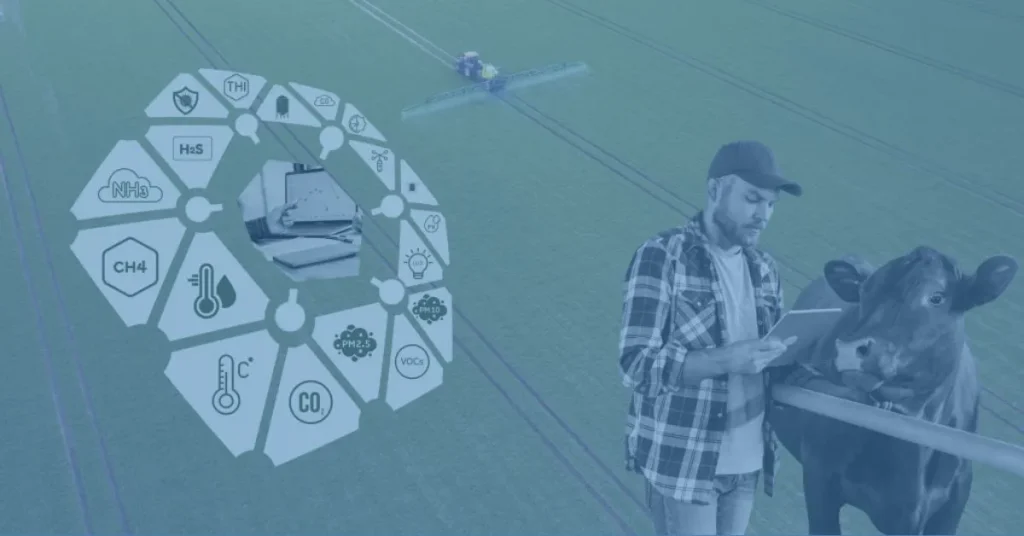
One can think of the use of collaborative robotics on farms (e.g., in milking); the use of GPS or indoor positioning for precision agriculture and livestock management in which activities and actions are determined per square meter or even per individual plant or animal; sensor systems that allow data to be collected and analyzed and used for monitoring and predictive analysis; or virtual fencing systems or monitoring of biological parameters of farm animals.
The applications of enabling technologies in animal husbandry and the agri-food sector are many and increasingly widespread and undoubtedly represent a huge opportunity for Italian production entities operating in this sector.
In addition to an advantage in terms of work quality and process optimization, innovations introduced with the use of enabling technologies give access to a series of tax incentives provided by the National Transition 4.0 Plan.
Incentives 4.0 for livestock and agriculture 4.0
INAIL Call, Tax Credit, New Sabatini, Mezzogiorno Credit, Financing, are several measures in the field to support and incentivize innovation in the agriculture and livestock sectors.
Measures under the National Transition 4.0 Plan require the use of enabling technologies as one of the requirements for accessing tax incentives. This is why they are so important.
Protagonists of Innovation and R&D projects, enabling technologies are the main drivers of the transformation to 4.0 and represent an opportunity in terms of economics and growth.
We have already talked about Tax breaks for the agribusiness sector: review the video of the 3rd Aperistalla
News coming soon
To learn more about the possibilities offered by the National Transition 4.0 Plan for agriculture and livestock farming and to learn about all the fiscal levers currently available for these sectors and the main news for the future attend the next Aperistalle, dedicated to this topic.